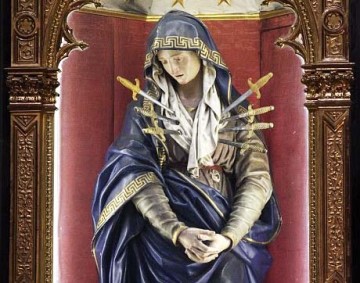
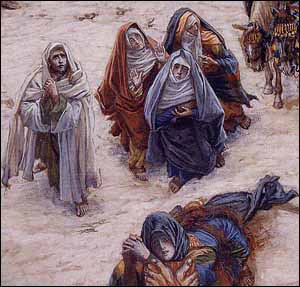
Summary: The scriptural basis for this memorial is found in the Gospel of John, especially where Jesus hands over Mary and John into each other’s care (Jn 19:25). Processions with the statue dedicated to Our Lady of Sorrows are still popular in Malta and in Spain.
Patrick Duffy takes up the story.
The Servite Order The Seven Holy Founders of the Servite Order in Florence are credited with starting the devotion to Our Lady of Sorrows in AD 1239, Stabat Mater This devotion must also have been developed by the plaintive Latin hymn Stabat Mater dolorosa, (See below) commonly attributed to Franciscan friar, Jacopone da Todi (1230-1306):
Stabat mater dolorosa
iuxta crucem lacrimosa,
dum pendebat filius.
(At the cross her station keeping, stood the mournful mother weeping, close to Jesus to the last.)
[ Full text of this hymn is quoted below.]
The Seven Dolours Different sorrows of Mary have been honoured in the Church’s history, but since the 14th century these seven have commonly been regarded as the seven dolours (sorrows) of the Blessed Virgin Mary:
Thine own soul a sword shall pierce..
The prophecy of Simeon
The flight into Egypt
The loss of the child Jesus for three days
Meeting Jesus on the way to Calvary
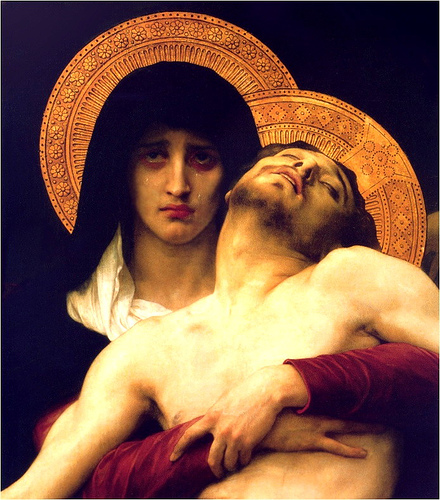
The crucifixion and death of her son Jesus
Jesus being taken down and given to her
Jesus being laid in the tomb.
Consenting with love to his offering In his Apostolic Exhortation Marialis cultus (1974) ordering the development of devotion to the Blessed Virgin Mary, Pope Paul VI writes of the faith and spirituality behind this devotion:
Mary, standing by the cross, suffered intensely with her only begotten Son and united herself as his mother to his sacrifice, consenting with love to the offering of the victim who was born of her, whom she offered to the eternal Father.
Stabat Mater
At the cross her station keeping
stood the mournful Mother weeping,
close to Jesus to the last;
Through her heart, his sorrow sharing,
all his bitter anguish bearing,
now at length the sword had passed.
Oh, how sad and sore distressed
was that Mother highly blessed
of the sole-begotten One.
Christ above in torments hangs;
she beneath beholds the pangs
of her dying glorious Son.
Is there one who would not weep
whelmed in miseries so deep,
Christ’s dear Mother to behold?
Can the human heart refrain
from partaking in her pain,
in that Mother’s pain untold?
Bruised, derided, cursed, defiled
she beheld her tender child
all with bloody scourges rent;
for the sins of his own nation
saw him hang in desolation,
till his spirit forth he sent.
O you Mother, fount of love!
Touch my spirit from above,
make my heart with yours accord:
make me feel as you have felt;
make my soul to glow and melt
with the love of Christ our Lord.
Holy Mother, pierce me through;
in my heart each wound renew
of my Saviour crucified:
Let me share with you his pain
who for all my sins was slain,
who for me in torments died.
Let me mingle tears with you, mourning him who mourned for me all the days that I may live:
by the cross with you to stay, there with you to weep and pray, is all I ask of you to give.
Virgin of all virgins best, listen to my fond request: let me share your grief divine;
let me, to my latest breath,
in my body bear the death
of that dying Son of yours.
Wounded with his every wound,
steep my soul till it has swooned
in his very blood away;
be to me, O Virgin, nigh,
lest in flames I burn and die
in his awful judgement day.
Christ, when you shall call me hence,
be your Mother my defence,
be your cross my victory.
While my body here decays,
may my soul your goodness praise,
safe in paradise with you.
Regret is not a proactive feeling. It is situated in disappointment, sorrow, even remorse.
It merely wishes things were different without an act to cause a difference. Repentance is different. Repentance is an admission of, hatred of,
and a turning away from sin before God.